Sunday, May 7, 2017

Reflection

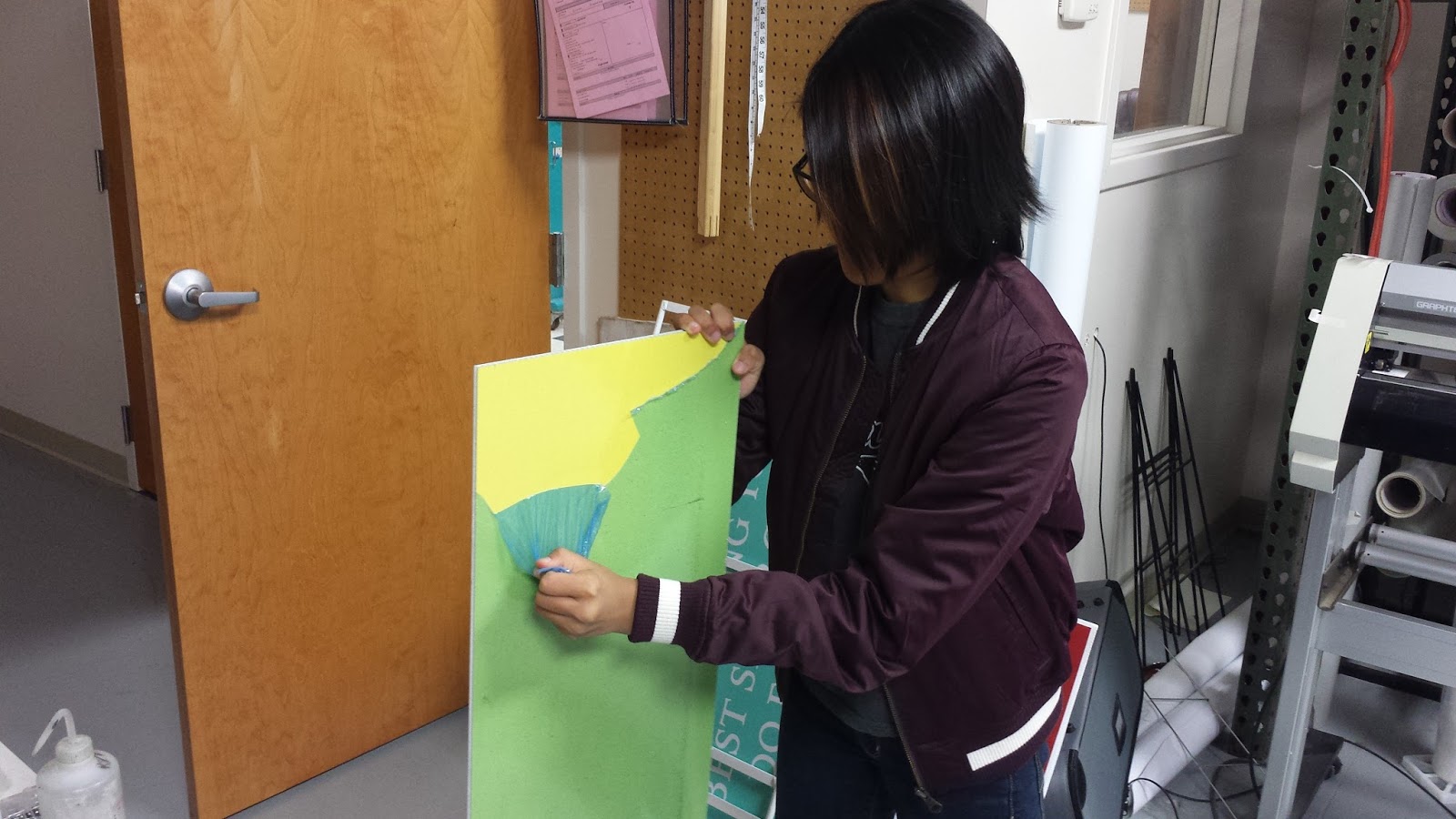
Working in a print shop is a behind-the-scenes experience as to how graphic design is integrated into physical and digital mediums.


   After completing this year's course of graphic design, my pursuit of a career in graphic design remains the same, but now I am knowledgeable of many more aspects on my preferred career field. Additionally, my technique of approaching client requested designs has grown to be more proficient and effective based on what I learned from this course. My advice for any other students who are considering the HMP course is that they ask as many questions regarding their field as they can. Additionally, establishing as many connections to people related and/or in your job field will be the best in terms of the future. Making the most of the hand-on experience of honors mentorship can be greatly beneficial for anticipating anything one can be unsure of in their job field.
   Over the course of the year, my mentorship has proved to be have given me a new perspective on how to take apart and assemble graphic designs. I was able to create and format my own designs on Adobe Creative Suite and have them printed for myself and real-life clients. In addition, I also created designs formatted for digital mediums and viewership. For example, details like DPI, vectors, and techniques of manipulating file size are all crucial when reaching the final product. Through this, I have learned the importance of file and design formats and aspects to be considered when designing for a multitude of mediums and client requests.
   Overall, being able to anticipate the manufacturing and printing process through my HMP course at Brandywine Printing Inc. has made me extremely confident in my ability to enter the graphic design field.

Sunday, March 26, 2017

Relevant Presentation

Pandering to my audience (especially due to my audience being mostly my student peers) seems extremely important due to the tone I wish to come across when presenting to my audience. Pulling off occasional jokes and occasional casual remarks will draw the interest of my audience and keep them focus on the speech at hand. I should additionally apply the importance of practicing beforehand avoiding procrastinating to the last minute as much as possible. This includes researching how others have presented projects similar to mine, and planning how I will present weeks beforehand. Lastly, I will also analyze natural body language and verbal aspects to my presentation.

Sunday, February 26, 2017

Annotated Bibliography #3

1. Source/Bibliography

Kenneth Fitzgerald and Timothy Goodman (2016), The Regional Design Awards. (2016). Midwest, 70(4), 93-120.

2. Summary

As an article within a volume collection of awarded graphic design entries, this passage highlights and provides visual examples of designs and design movements originating in the American Midwest. The awarded designs describe the artists intention and purpose, analyze their design(s) and/or graphic design movement, and point out the major contributions to American society and culture that make them significant in 2016. These awarded designs range from a large array of objectives from the artists and their commissioners, such as social movements, advertising, propaganda, logos, and more.

3. Potential Quotes


  •  “...he pondered a few simple questions: Is it adventurous? Does it take risks? Is it original or is it just replicating a tired trend?” 
  • “20 Liters is an international nonprofit organization based in West Michigan helping to raise funds and awareness of the global water crisis facing our world,”
  • “The Structure mark represents a new way of thinking. Heavily tech influenced, the mark uses colors that are saturated to their most vibrant point. Clashing and bold, Structure is both a disruptor and a connector within the complex puzzle that is the Internet of Things.”
  • “As an agency that produces millions of meal bags for kids, we know it's not just about holding food. Each bag says something not only about its restaurant brand and the food they offer, but also about the parents who buy it, and most of all the kid who tears into it. This bag serves as an introduction to our work, our thinking and our personality."


4. Assessment/Evaluation of Source

Graphic designer, art director, author, and competition judge Timothy Goodman has worked for many renowned clients such as The New York Times, Apple Inc., Samsung, Target, and many other clients. He collected the winning competition entries and is directly quoted and interviewed for the descriptions of each entry and why he chose them. Additionally, the author of the article emphasizes and brings forth direct quotes from design teams, companies, and clients that support the design's success. For further credibility and description, all designs are annotated with direct links and sources so that the reader may look into more of the design's context, as well as the names and professions of those who worked on them.

5. Reflection

This article provides a wide variety of examples of the purpose and capability of graphic design and will be a great reference to pick and choose for different contexts and uses of exceedingly exceptional graphic designs in industry and more personal usages.

Sunday, February 12, 2017

Capstone

Most importantly, I will be focusing on the visual aspects of my capstone project since my aarea of interest focuses on graphic design. This will include compiling various graphic examples that may be presented physically or digitally through a presentation (Prezi will be ideal for a more graphically-pleasing presentation format). Additionally, I will interview a few graphic designers from my class and internship to quote throughout my presentation.

Sunday, February 5, 2017

Annotated Bibliography #2

1. Source/Bibliography

Ulloth, D. R. (2007). The Artistic Ideals of Graphic Design Artists in the Television Industry: The Developing Standards of a New Art Form.
Lewiston: Edwin Mellen Press.

2. Summary

Leaning to the usage of graphic design in the television industry but still acknowledging its other variations, this textbook focuses on multiple accounts taken from a wide variety of graphic designers along with excerpts taken from analytic data and art history to present well-rounded passages about the industry and production of graphic design. The textbook also describes the general graphic design basis over different time periods in American history and different workplace settings. Several chapters analyze what to expect as a worker and/or consumer in the graphic design industry, what misunderstandings and mistakes one can come across, and what skill-sets best apply when on job.

3. Potential Quotes

~ “The images help attract users, brand media products, create program or section identities (openers), and assist consumers in navigating through a vast array of content.”
~ “The bold flaunting of the traditional rules troubled writers and others (…) at the annual Visual Communication Conferences'? addressed the approach to picture design from numerous perspectives including semiotics and historical practices in an attempt to understand or judge the work of music videos.”
~ “The process includes three aspects or elements: (a) the work of art or an object existing in nature; and (b) an emotion that results from (c) contemplating the work. The object itself could be described by three factors identified by Berndston4: (a) sensation associated with a visual component such as a color i.e. green from the leaves of trees, (b) representation of the color and its related objects on canvas as portraying the forest, and (c) structure or the relationship among the components of the painting.”

4. Assessment/Evaluation of Source

The book provides info from various interviewed graphic designers in several work environments and their first-hand experiences in the field, along with excerpts about art history, art theory, and quantitative data collected by credible researchers and historians. As a collection of sources, this textbook additionally contains a well-rounded combination of viewpoints and perspectives, along with multiple examples of events and experiences that take place on the workplace by actual graphic design employees.

5. Reflection

This source will be great when referencing and quoting the thoughts of other graphic designers in a industrial, company setting. Additionally, I can apply the ideas and principles derived from these interviews to know what to expect in the graphic design industry as a whole. Each chapter tackles a different areas of subject in the industry (education requirements, principles of visual communication, etc...) and deconstructs all the details collected from data, history, and interviewees.

Sunday, January 29, 2017

Graphic Organizer #2

Name: N Jairus Banaag
Source / Bibliography
(APA format)
Ulloth, D. R. (2007). The Artistic Ideals of Graphic Design Artists in the Television Industry: The Developing Standards of a New Art Form.
Lewiston: Edwin Mellen Press.
Annotation:
(Describe ALL info. that might be important for your paper. Explain to the reader and/or summarize what might be found in this source)
Leaning to the usage of graphic design in the television industry, but still acknowledging its other variations, this textbook focuses on multiple accounts taken from a wide variety of graphic designers along with excerpts taken from analytic data and art history to present well-rounded passages in the industry and production of graphic design.
Potential Quotes:
(Are there any significant quotes you can use or paraphrase from this source?)
  • “The images help attract users, brand media products, create program or section identities (openers), and assist consumers in navigating through a vast array of content.”
  • “The bold flaunting of the traditional rules troubled writers and others (…) at the annual Visual Communication Conferences'? addressed the approach to picture design from numerous perspectives including semiotics and historical practices in an attempt to understand or judge the work of music videos.”
  • “The process includes three aspects or elements: (a) the work of art or an object existing in nature; and (b) an emotion that results from (c) contemplating the work. The object itself could be described by three factors identified by Berndston4: (a) sensation associated with a visual component such as a color i.e. green from the leaves of trees, (b) representation of the color and its related objects on canvas as portraying the forest, and (c) structure or the relationship among the components of the painting.”
Assessment:
The book provides info from various interviewed graphic designers in several work environments and their first-hand experiences in the field, along with excerpts about art history, art theory, and quantitative data.
Reflection:
(How will you potentially use it?)
The various reflections and interviews can be analyzed to interpret what many designers agree, and disagree in terms of a good graphic design. Additionally I can support my knowledge with info gathered from the art history of graphic design from previous designers.


Sunday, January 22, 2017

January 16

The goal of researching for my essential question, "How do I develop a graphic design that is memorable, effective, and changes the audience", is to find and apply the key factors in visual communication most that efficiently and effectively persuades/informs an audience. Graphic designs can often be easily be forgettable, bland, or even inefficient in their purpose. I wish to find graphics that exceed their purpose in marketing and other fields of use. To provide an adequate presentation, I could pick some visual mediums such as graphics and small motion presentations to give examples and input in the most relatable way possible. Additionally for my project's "real inquiry", I could analyze my fellow students and my own designs/clients in my Graphic Design II class, as well as interviewing other graphic designers and their experiences (whether they be independent, in a company, and so on).

Sunday, January 15, 2017

Interview with Graphic Designer + Reflection

1.What is the most common mistake people send/request in a graphic design?
Most people do not realize the importance of image quality of pictures and/or logos. They see the items on their computer screen and feel that if they look good on the screen then that is the way it will print. NOT TRUE! Computer screen resolution (72dpi) and good print quality resolution (150 dpi for large format printing to 300 dpi small format printing) are very important to ensure optimal print quality. Logos should be Vector for best results and HIGH RESOLUTION images.

Reflection: Vectors should be ALWAYS be used and considered when creating designs in a disparity of sizes/resolutions (such as a logo), and should have a flexible format. Although, I would need to outweigh file size vs file quality when creating designs.

2. What do you think is the most important aspect of a graphic design?
Listening to the client. The job is to get the clients message out as they intend in the actual design.

Reflection: Clients often know what they want and need, so always weigh their requests over your ideas on a design. Interpersonal skills and communication is key.

3. What do clients often look for the most in graphic designs.
• Trends
• Knowledge
• Professionalism

Reflection: People should consider their design in the context of the client/company, modern day associations, and possible meanings/usage of the design in the future. I should delve into as much research as I can when creating concepts and thumbnailing.

4. What do you look for the most in a graphic design?

I always try to use simple, clean fonts in my designs. Easy to read fonts get the message out better and just overall are more appealing.

Reflection: Fonts are very important since they are the essence of giving details and information! If the audience has a hard time reading/interpreting text, the purpose of the design will be thrown completely off course. Some fonts may seem dynamic and/or unique, but ALWAYS prioritize legibility.

5. When creating designs, can you summarize the concept-creating process?

• Speak with the client or get their notes on their vision, colors, images, size of piece, etc.
• Rough draw out any or all basic elements.
• Go to work on the actual layout on the computer. Some ideas will work, others won’t. adjust ideas as needed.

Reflection: This is similar to the process I use now! My graphics teacher also encourages this process, and it is often repeated that the steps should not be skipped and/or rushed over to create optimal, quality designs.

6. How do you determine what the audience/client would appeal to the most in a design? Examples?

If you have initially listened to the client, you should have most of the design covered and and the client should be happy. There may be some elements that need edited or omitted. There are however some clients
that are difficult. Some have ideas in their head that they didn’t communicate and when they see a proof, they are not happy with the design. In that case, let them know that you need to know what they expect so that you can deliver for them. They came to you for your expertise and with everything communicated properly, you can give them what they are looking for.

Also, go online and search various design sites for trends, cutting edge designs and others layouts. It opens up other ideas for you to explore.

Reflection: This is another thing to consider when dealing with interpersonal skills and dealing with clients. I should be ready to deal with possible difficulties and mistakes that I'll need to overcome throughout the entire process.
Additionally, research research research!

7. Do you have any tips when communicating what you and a client want in a design?

The tip I have as far as the initial meeting with a client is to let them be aware of your time.
Many people think they are the only client you are working with, when in reality they are just
one of many. Just be sure to let them be aware of the timeframe it will take you to give them
the initial layout. Be up front with them about your proofing process. If for example, you are
are charging them a lump sum for their project, let them know that they will get one (1) design
and two (2) revisions in that price or whatever it may be. A lot of clients want to nickel and dime
you and going into their job to make multiple edits here and there costs you more time.

Reflection: I must consider possible outcomes/options through the production of products should be communicated to the client so that they are well-informed and expectant.

8. What is the most challenging design you have faced?

I haven’t had one most challenging design, I have had several.
As I mentioned prior, some clients do not elaborate on their ideas or just don’t exactly
know what they want in a design, but just know they want something and when you present
them with the initial design, they are not happy with it and can’t give you any input as to why,
but just know they don’t like it and want to go in another direction. That type of thing does
happen and it makes you have to go back and try a new vision based on not a lot of info from
the client.  

Reflection: Try as much as you can to ask for necessary amounts of info to complete a design, but be ready if you have to work with insufficient info.

9. Does anyone ever get onto you for copyrighted fonts, logos, etc...? If so, how do you avoid this?

I haven’t had any issues with copyrighted material. If you use fonts that were purchased by you and use your own work, there won’t be any issues with it.

Reflection: I will continue to look up copyright rules on fonts I pull off online and ones that have already been purchased.

10. Do you ever need to communicate with other graphic designers over a certain design? How should this be handled?

I never have communicated with other designers on a project that I was designing, so I can’t give any input on this.

Reflection: I personally experience this in graphics class whenever we recieve clients. We often give one another constructive criticism and bounce back ideas on one another. This may be different in a workplace setting, though.

Sunday, December 18, 2016

My Essential Question

How do I develop a graphic design that is memorable, effective, and changes the audience?

* Why did you select this as your essential question?

Graphic designs have been known to inspire movements, propaganda, ideas, and other grand changes in society in history, but they can just as easily become plain and forgettable. Since I wish to grow and work at the best of my ability in the field, I hope to learn how to exceed standards.

* What excites you most about finding the answer to this essential question?

I would not only be able to apply it to all my designs and creative process, but also using to make visual communications that reaches the audience in the best way possible.

* Do you feel that this question accurately reflects a desire/need that you have to find out more about this topic?

Yes, with all given factors that could be incorporated to design, I've wondered if there are a key set of attributes that make a successfully memorable design.

Sunday, December 4, 2016

Nov 28 Reflection

Article Source

The youth of today may have received limited knowledge of situations they may approach in a work place due to their educators having a flawed and/or inflexible to what is realistic. Additionally, beginning in a new field leaves an empty vacuum of where previous experience and memories should be, because like muscle memory, taking action leaves a better impression for future events. Social intelligence is crucial when working with a variety of clients and coworkers and getting the best impressions and conversations out of them. This form of intelligence helps an individual know the etiquette of a work setting, along with a clients' personal needs, such as physical language, verbal language, impressions, attitude, and more. I personally need to apply such skills when explaining to clients the complications of certain aspects of visual communications in different scenarios.

Sunday, November 13, 2016

Partner in Education Q&A


  • In regards to your internship site, explain how you feel they are a "partner in your education"
At Brandywine, they keep me busy and do their best to make my internship experience involved and useful. Whenever I visit, they find jobs and tasks for me that best fits my skill level, and they gladly assist and educate me whenever I have questions and/or problems. Each member of the facility work together to accommodate my needs in this educational experience by telling me what they know best and referring me to each other.
  • What have you done that has made your supervisor's life easier?
I try my best to finish any printing processes Mr. Brooks is working on, such as setting up tools, supplies, among other things. By completing more products and speeding up the process, I hope to cut the time and effort needed to produce quality orders before their deadlines. When other tasks are unavailable, I file and organize clients' proofs.

  • What goals have you met so far?  Have you changed any of your goals?
I have established myself as a novice, but reasonable graphic designer, and I have already worked with one real-life client's needs. 

Monday, October 31, 2016

Oct 24 Q & A

  • How has your perception of the internship/organization changed since you started the internship?
At first, I was unsure how being in an internship at a printing facility would reinforce my graphic design skills, but now I have been enlightened with the process behind graphic design, and how printing requires certain aspects that should be considered when designing.
  • What is surprising you about this internship?
There is a various array of printing mediums that I was unaware that graphic design would be needed for, and I learn and observe a new type each session. Additionally, with each type I also learn the various protocols and precautions when designing specific products, including re-sizing quality, bleed, and so forth.
  • What have you learned from the routine or boring parts of the internship?
I often observe how my manager handles customers and process orders, proofs, and production. This often includes the process of filing data for proofs and orders, and collecting customer info through email communication.

Sunday, October 30, 2016

Jairus' Mentorship Write Up


My Profile:
I have been passionate in visual arts as long as I can remember, and after being introduced to graphic design by Forsyth Central High School's splendid art department, I knew it would be a field I could delve into.

As a high school junior who has taken 2 years of graphic design classes, I have put out many designs for the school, such as a poster for the drama department's most recent act, Pippin. Additionally, I have taken part in assisting my fellow graphic design students. I strive to do my best in the subject and build upon improvement, and I have taken the responsibility of enrolling in an internship program provided at my high school to achieve this.

My Mentorship:
At a local business which provides graphic design and printing services, Brandywine Printing Inc is where most of my internship takes place. My manager and mentor Mr. Brooks instructs me on all the protocols and functions required to produce the best quality in his business.

In my time there, I observe several different mediums of print, and I learn how files created in a graphic design are interpreted by the machines and programs. By this, I have become aware of rules and techniques to follow while designing whenever I put what and how an order is printed into consideration.

My future: 
I plan to apply this experience as credentials to any possible graphic design jobs and/or education, alongside being able to know how to react in a real-time business environment. Next year, I hope to get into a higher graphic design course and an additional marketing principles course to reinforce skills in my preferred field of work.

Sunday, October 23, 2016

(Reflection) "Graphic Design: Fine Art or Social Science?"


I delved into this source to find out what graphic design is and why so crucial in business and society. This passage by Jorge Frascara, professor of visual communications and chairman of art and design, focuses on graphic design's socially understood definition, its fluid usage and interpretation throughout history, and its flaws and misunderstood assumptions. The article, covering information collected in 1984-2010, is a short excerpt from a volume of Design Issues. The 12 pages of the excerpt are extremely descriptive and provides several accounts and figures as examples to prove the author's point. For instance, a figure of a design for a product, which failed in its purpose due to the graphic being loosely related to its product and purpose (Frascara describes this as an inefficiency in communication). Inevitably, the example given proves graphic design's importance in properly reaching its audience. Other than marketing, Frascara also provides examples of propaganda and typography which also hold important roles pertaining to the purpose of graphic design.

Overall, the main points of the article are the importance of influence of visual communications on its audience. Not only is there an artistic aspect, but also the incorporation of sociology, marketing, psychology, and other important ideas needed to effectively change an audience.

Sunday, September 25, 2016

Work Ethic

Work ethic is a quality that benefits a worker in a variety of situations, and it is a key factor in how and whether of not a person can complete jobs and tasks efficiently and accurately. The three main qualities that compromise work ethic are ability to use interpersonal skills, initiative, and dependability. Interpersonal skills are vital to co-worker and customer interaction. Additionally, having an initiative when carrying out tasks to get them completed quickly and efficiently. Finally, applying dependability to everyday work so that one can be trusted with important information and jobs. Altogether, these three components make the ideal worker to any employer.

In my OWEI, I received a score of 5.81 in interpersonal skills, 6.31 in initiative, and 5.86 in dependability. All traits were scored out of 7, and I scored the most in initiative. I've learned that I can possibly work on my interpersonal skills and sense of dependability. In my workplace throughout the year, I will strive to be more socially interactive and be more dependable with clients and co-workers. Alongside improvement, I will use my initiative trait to its fullest capability and advantage.

Communication

With communication, the forms and ways a person uses it are extremely important to reach an audience. Additionally, each type of audience have specific forms of communication that meet their wants and affect them the best. One's way of communicating is part of a preface that lets an audience know their personality and demeanor, such as a sense of professionalism or humor. For example, a chat with your friends can be informal and casual. Therefore, your word choice and tone can be loose and humored, along with a relaxed and free body language. In contrast, a chat with your family members often can be casual but respectful. Ultimately, communication with employers should be taken with the utmost professionalism needed for each employment, or else your employer may reconsider whoever is communicating as an employee. This includes having good posture and active listening.

In my internship at BrandyWine Printing, although the employment isn't as strict compared to a medical or science environment, still requires an amount of professionalism and respect in terms of communication. Especially in the presence of customers, word choice should be kept formal and friendly. I would need show I am actively listening to my mentor and give detailed feedback relating to the task at hand. I would also need to actively move around and work with my hands at the printing press, showing involvement and work ethic.

Sunday, September 11, 2016

Article Reflection

"Getting Ready for Your Mentor" depicts how a student can make the most out of their mentorship opportunities and how to be to most resourceful, compliant student intern to an employer, instead of simply sitting down and attending each internship. This article should be treated as a checklist and guide to being an acceptable mentorship student and using the resources to benefit their passion in their career field.

After the basic tips for starting an internship are cleared up, the top seven strategies in an efficient internship are listed and explain. Firstly, one should have a good sense of professionalism, such as dress code and expectations, are priority. Secondly, they need an enthusiastic attitude is always sought out and values by employers. Then, they should immerse themselves in their jobs and tasks, and becoming acquainted in their workplace. Next, they need to provide top-quality work without complaint, and they should additionally be actively pursuing new opportunities by discussing it with mentors and volunteering assistance. Lastly, to ultimately take advantage of an internship, students should apply this experience to their portfolio and become acquainted with the network of professionals and experienced people in their field. The article also refers to the protocols of the class course and what to do upon leaving. When a student applies all of the above, they can make their success a reality.

Thursday, September 8, 2016

Leadership Skills


I created a short time lapse drawing video about being an effective leader, inspired by the HMP presentation given (August 29)

Wednesday, September 7, 2016

JD Russo - Awareness is Not Enough (August 29)


Indifference, as described in JD Russo's TED Talk's speech, is the true obstacle of action, despite popular belief in it being the idea of ignorance. Personally, I believe indifference is an is growing issue with myself, and I wish to confront it straightforwardly in my Mentorship by becoming more involved. By interacting and asking how I can increase my productivity in the program,  can stay focused on my goals and bring out the best in my HMP pursuits.

Tuesday, August 23, 2016

Beginning of Mentorship

At BrandyWine Printing Inc., I would like to make the best of my mentorship when exploring printing and graphic design through on-hand experiences. I will do this by observing clients that come and go in the office, and by participating in printing orders when I can and to the best of my ability. By observation and training I can learn the precautions, protocols, and tasks when dealing with a wide variety of orders and requests. As a graphic designer, learning how the process of printing designs works, I can expect and consider the steps beforehand whenever creating a new design for clients.